Confused about CRM vs ERP? Learn the key differences, benefits, and which system your business really needs to grow efficiently.
Table of Contents
Introduction
If you’ve been researching business software lately, you’ve probably come across the debate around CRM vs ERP. At first glance, they seem similar—both promise to organize your business, improve efficiency, and boost growth.
But once you dig a little deeper, the differences become clear… and choosing the wrong one can cost you time, money, and a lot of frustration.
So how do you figure out what your business actually needs? Let’s break down CRM vs ERP in a way that makes sense—no jargon, no confusion, just practical insight you can use.
What Is CRM?
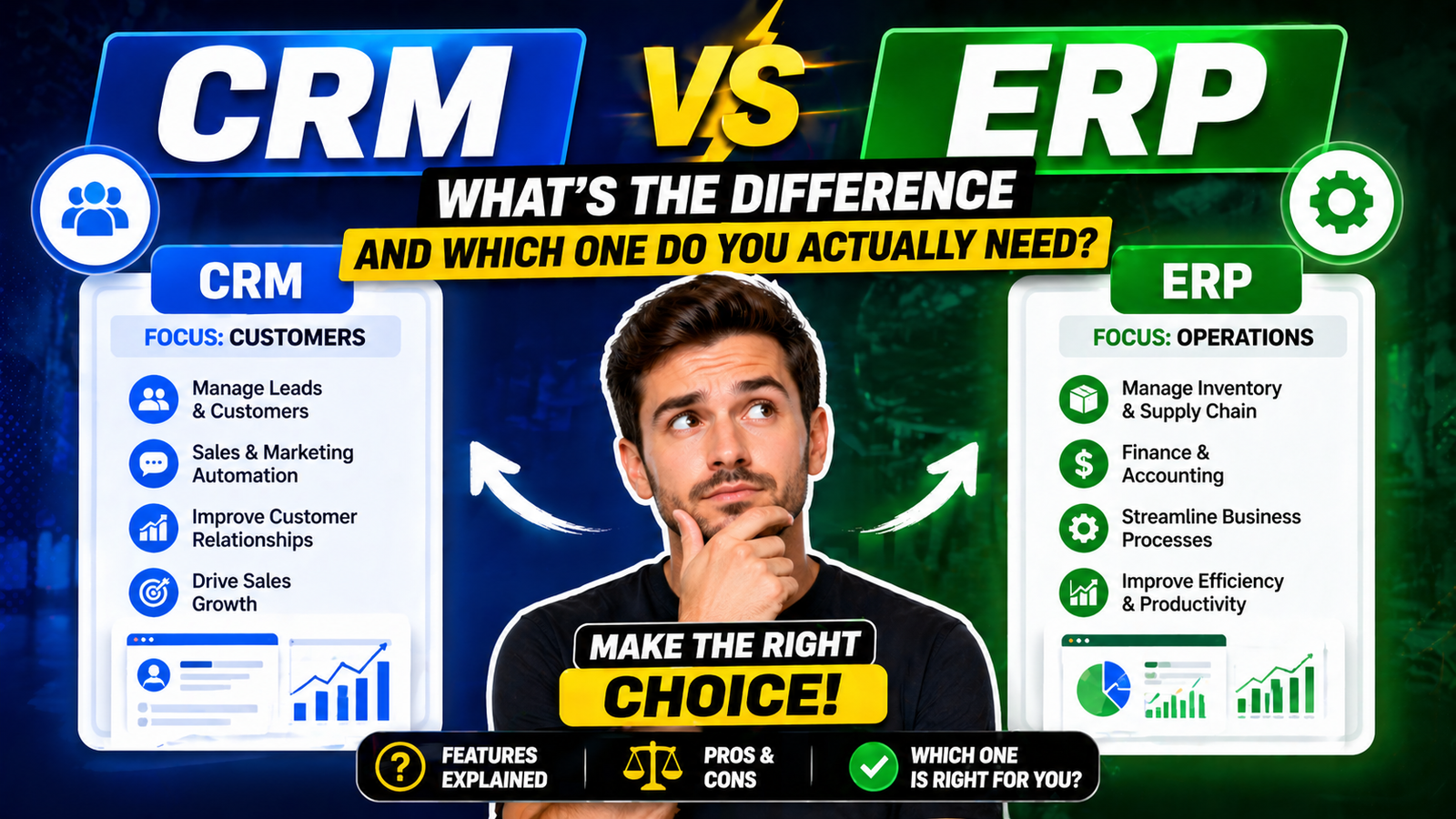
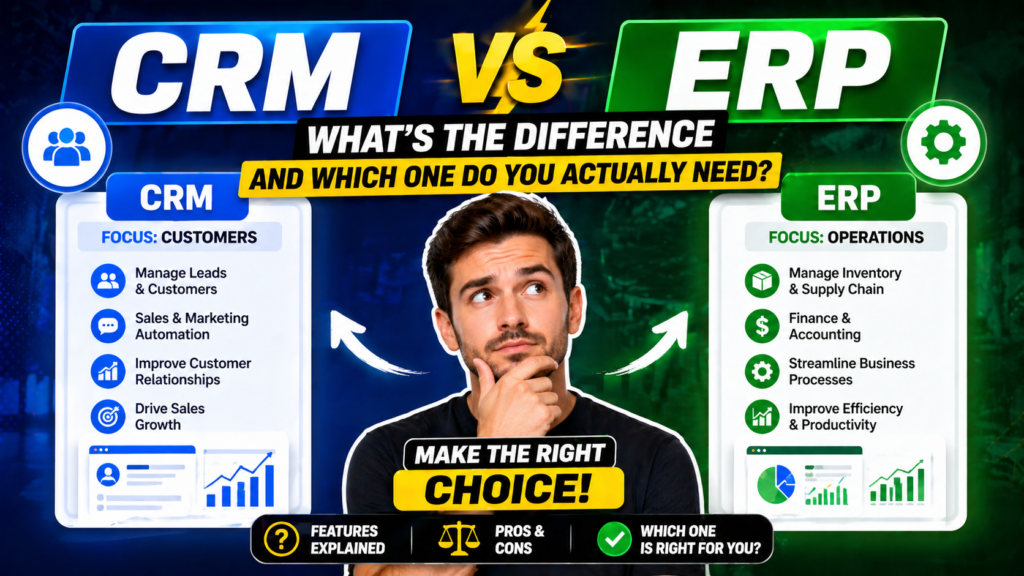
CRM stands for Customer Relationship Management. It focuses on managing interactions with your customers and prospects.
In simple terms, a CRM helps you:
- Track leads and sales pipelines
- Manage customer communication
- Automate follow-ups
- Improve customer relationships
If you want a deeper understanding, this overview of Customer Relationship Management explains how it works.
When comparing CRM vs ERP, CRM is all about the front-end—sales, marketing, and customer experience.
What Is ERP?
ERP stands for Enterprise Resource Planning. It’s designed to manage internal business processes.
An ERP system typically handles:
- Accounting and finance
- Inventory management
- Human resources
- Supply chain operations
You can explore more about Enterprise Resource Planning to see how it connects different departments.
In the CRM vs ERP comparison, ERP focuses on the back-end—operations and internal workflows.
CRM vs ERP: Key Differences Explained
Now let’s get to the core of it.
1. Purpose
- CRM: Manages customer relationships and sales
- ERP: Manages internal business processes
This is the most fundamental distinction in CRM vs ERP.
2. Users
- CRM is used by sales, marketing, and support teams
- ERP is used by finance, HR, and operations teams
Different teams, different priorities—that’s why CRM vs ERP isn’t interchangeable.
3. Data Focus
- CRM deals with customer data
- ERP handles operational data
Understanding this helps clarify the CRM vs ERP decision.
4. Implementation Complexity
- CRM systems are generally quicker to set up
- ERP systems often require more time and customization
This difference matters a lot when choosing between CRM vs ERP.
5. Cost
- CRM tools are usually more affordable for small businesses
- ERP systems can be expensive due to their broader scope
Budget is often a deciding factor in CRM vs ERP discussions.
When Should You Choose CRM?
A CRM is the right choice if your main goal is growth through better customer management.
Choose CRM if you:
- Struggle to track leads
- Want to improve sales performance
- Need better customer communication
- Run marketing campaigns regularly
Popular tools like HubSpot CRM make it easier to manage customer interactions.
For many small and mid-sized businesses, CRM is the first step before even considering CRM vs ERP at a deeper level.
When Should You Choose ERP?
ERP makes sense when your business operations become more complex.
Choose ERP if you:
- Manage inventory or supply chains
- Need integrated financial reporting
- Have multiple departments to coordinate
- Want centralized operational data
Platforms like SAP ERP are widely used for this purpose.
In the CRM vs ERP debate, ERP is typically chosen by businesses focused on operational efficiency.
Can You Use CRM and ERP Together?
Yes—and in many cases, that’s the best approach.
Instead of choosing strictly between CRM vs ERP, many businesses integrate both systems.
Why Integration Works
- CRM handles customer-facing activities
- ERP manages internal operations
- Together, they provide a complete business view
For example:
- A sale tracked in CRM can automatically update inventory in ERP
- Customer data can align with billing systems
This combined approach often resolves the limitations of choosing only one side in CRM vs ERP.
Benefits of CRM
Let’s look at what CRM brings to the table:
Improved Sales Tracking
You always know where deals stand.
Better Customer Relationships
Personalized communication becomes easier.
Automation of Repetitive Tasks
Follow-ups and reminders run automatically.
Increased Revenue Opportunities
Better insights lead to smarter decisions.
These benefits make CRM a strong contender in the CRM vs ERP comparison for growth-focused businesses.
Benefits of ERP
ERP shines in operational efficiency.
Centralized Data Management
All departments work from one system.
Streamlined Processes
Reduces duplication and errors.
Better Financial Control
Accurate and real-time reporting.
Scalability
Supports long-term business expansion.
These strengths highlight why ERP is essential in the CRM vs ERP discussion for larger organizations.
Common Mistakes to Avoid
Choosing between CRM vs ERP isn’t always straightforward. Here are some common missteps:
Assuming One Can Replace the Other
They serve different purposes.
Ignoring Business Needs
Always start with your actual challenges.
Over-Investing Too Early
Small businesses often don’t need full ERP systems immediately.
Skipping Integration Planning
Think long-term, not just immediate needs.
Avoiding these mistakes makes the CRM vs ERP decision much clearer.
External Resources
- Learn more about CRM systems here: https://en.wikipedia.org/wiki/Customer_relationship_management
- Explore ERP concepts here: https://en.wikipedia.org/wiki/Enterprise_resource_planning
Conclusion
The debate around CRM vs ERP isn’t about which system is better—it’s about which one fits your current business needs.
If your focus is on customers, sales, and growth, CRM is likely your starting point. If your operations are becoming complex and harder to manage, ERP might be the right move.
And for many businesses, the real answer isn’t choosing one over the other—it’s knowing when to use both.
Take a step back, look at where your business stands today, and make a decision that supports your next stage of growth.
FAQ Section
1. What is the main difference between CRM and ERP?
CRM focuses on managing customer relationships, while ERP handles internal business operations like finance and inventory.
2. Can a small business use ERP software?
Yes, but many small businesses start with CRM first and adopt ERP as they grow.
3. Is CRM cheaper than ERP?
Generally, CRM systems are more affordable, while ERP solutions tend to be more expensive due to their broader functionality.
4. Do I need both CRM and ERP?
Not always. It depends on your business size and complexity. Some businesses benefit from using both together.
5. Which is easier to implement, CRM or ERP?
CRM systems are typically faster and easier to implement compared to ERP systems.
6. Can CRM and ERP be integrated?
Yes, many modern systems allow integration, giving businesses a complete view of both customers and operations.
