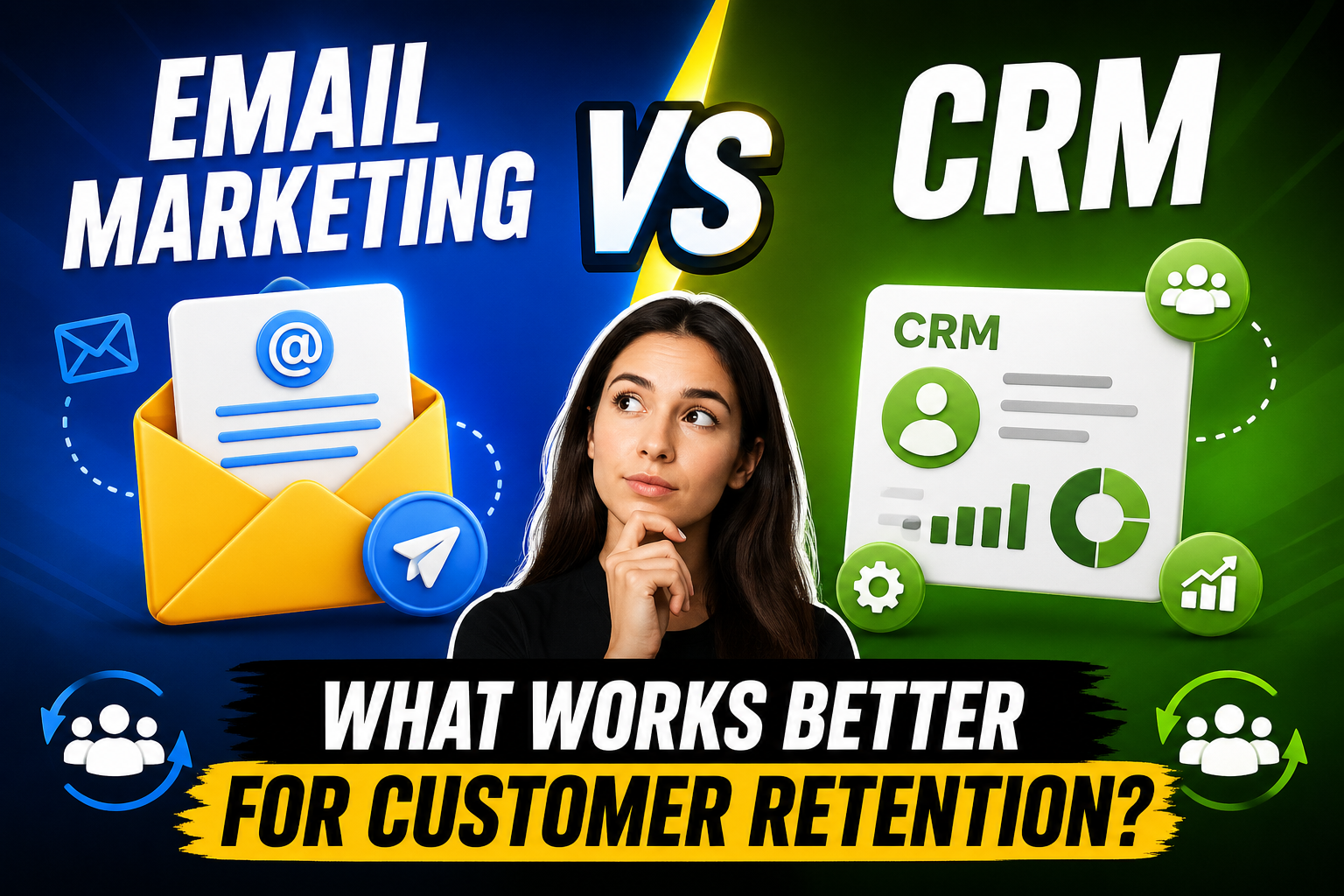
Email marketing vs CRM explained. Learn which works better for customer retention, engagement, and long-term business growth.
Table of Contents
Introduction
Keeping customers is harder than getting them. That’s something most businesses learn the slow way.
You might be running email campaigns, sending offers, and staying in touch—but still noticing that customers don’t come back as often as you’d expect. On the other hand, you may have a CRM system full of data, yet struggle to turn that information into real engagement.
That’s where the debate around email marketing vs CRM becomes important. Both tools are powerful, but they work differently—and choosing the right approach can directly impact your customer retention.
Let’s break it down in a practical way so you can understand what actually works and where each one fits.
What Is Email Marketing?
Email marketing is exactly what it sounds like—sending targeted messages to your audience through email.
It’s commonly used for:
- Promotions and offers
- Newsletters
- Product updates
- Customer engagement
Platforms like Mailchimp have made it easy for businesses to run campaigns at scale.
In the email marketing vs CRM discussion, email marketing is more about communication and outreach.
What Is CRM?
CRM stands for Customer Relationship Management. It focuses on managing customer interactions and data.
A CRM system, based on Customer Relationship Management, helps you:
- Track customer behavior
- Manage sales pipelines
- Store interaction history
- Improve follow-ups
In the email marketing vs CRM comparison, CRM is more about organization and long-term relationship building.
Email Marketing vs CRM: Key Differences
Let’s look at how these two tools differ in practical terms.
1. Purpose
- Email marketing focuses on communication
- CRM focuses on data management and relationships
This is the core distinction in email marketing vs CRM.
2. Functionality
- Email marketing sends campaigns to audiences
- CRM tracks customer interactions and sales activity
Understanding this helps clarify the email marketing vs CRM decision.
3. Data Usage
- Email marketing uses segmented lists
- CRM stores detailed customer profiles
This difference shapes how businesses approach email marketing vs CRM.
4. Automation Scope
- Email marketing automates campaigns
- CRM automates workflows and processes
Automation plays a different role in email marketing vs CRM.
5. Customer Retention Impact
- Email marketing keeps customers engaged
- CRM builds deeper relationships over time
This is where email marketing vs CRM becomes especially important for retention.
How Email Marketing Helps with Customer Retention
Email marketing is one of the most direct ways to stay connected with customers.
Benefits:
- Regular Communication
Keeps your brand top of mind - Promotional Campaigns
Encourages repeat purchases - Personalized Content
Improves engagement rates - Automation
Sends messages at the right time
In the email marketing vs CRM debate, email marketing excels at maintaining consistent communication.
How CRM Improves Customer Retention
CRM systems work behind the scenes, but their impact is significant.
Key Advantages:
- Customer Insights
Understand preferences and behavior - Follow-Up Tracking
Never miss an opportunity - Personalized Interactions
Tailor communication based on history - Long-Term Relationship Building
Focus on customer lifetime value
Tools like HubSpot CRM show how powerful CRM systems can be.
This is why, in the email marketing vs CRM comparison, CRM often drives deeper retention.
Which One Works Better for Customer Retention?
Here’s the honest answer: it depends on how you use them.
Email Marketing Wins When:
- You want to engage large audiences
- You run frequent campaigns
- You focus on promotions and updates
CRM Wins When:
- You want to understand customer behavior
- You focus on personalized interactions
- You manage long-term relationships
In reality, the email marketing vs CRM debate isn’t about choosing one over the other—it’s about using both effectively.
Why Combining Both Works Best
The smartest businesses don’t choose between tools—they integrate them.
When you combine email marketing with CRM:
- CRM provides data
- Email marketing delivers communication
For example:
- CRM tracks customer behavior
- Email campaigns are tailored based on that data
This integration resolves the limitations of email marketing vs CRM as a standalone choice.
Real-World Example
Let’s say you run an online store.
Without Integration:
- You send generic emails
- Customers receive irrelevant offers
With CRM + Email Marketing:
- CRM tracks purchase history
- Emails are personalized
- Customers receive relevant offers
The result? Higher engagement and better retention.
This is where the email marketing vs CRM discussion becomes practical.
Common Mistakes to Avoid
Even with the right tools, mistakes can reduce effectiveness.
Over-Sending Emails
Too many emails can annoy customers.
Ignoring CRM Data
Data is useless if not used properly.
Lack of Personalization
Generic communication doesn’t build loyalty.
Not Integrating Systems
Disconnected tools reduce efficiency.
Avoiding these mistakes improves your results in the email marketing vs CRM approach.
External Resources
- Learn more about CRM systems: https://en.wikipedia.org/wiki/Customer_relationship_management
- Explore email marketing basics: https://en.wikipedia.org/wiki/Email_marketing
Conclusion
When it comes to email marketing vs CRM, the real question isn’t which one is better—it’s how they work together.
Email marketing keeps the conversation going. CRM ensures that conversation is meaningful.
If you rely only on email, you risk being generic. If you rely only on CRM, you may miss opportunities to engage.
The best strategy is simple: use CRM to understand your customers, and email marketing to stay connected with them. That combination is what truly drives long-term retention.
FAQ Section
1. What is the difference between email marketing and CRM?
Email marketing focuses on communication through campaigns, while CRM manages customer data and relationships.
2. Which is better for customer retention?
Both are effective, but CRM provides deeper insights, while email marketing helps maintain engagement.
3. Can email marketing work without CRM?
Yes, but it may lack personalization and detailed customer insights.
4. Do I need both CRM and email marketing tools?
Using both together provides the best results for customer retention and engagement.
5. How can I integrate email marketing with CRM?
Most CRM platforms offer built-in integrations with email marketing tools for seamless data sharing.
6. Is email marketing still effective in 2026?
Yes, it remains one of the most cost-effective ways to engage and retain customers.
